
The World Trade Organisation report predicts that global trade in goods will rebound in 2024. However, the optimistic forecast for international trade faces downside risks due to factors such as geopolitical tensions and economic policy instability.

On 10 April, the World Trade Organisation released Global Trade Overview and Data. The report predicts that global trade in goods will rebound in 2024, ending the contraction in trade volume in 2023. The report also noted that regional conflicts, geopolitical tensions, and economic policy uncertainty also pose significant downside risks to international trade.
In 2023, the report says, most parts of the world, including Europe, North America and Asia, have weak import demand, with only regions such as the Middle East achieving high growth as an exception. In this broader environment, international trade saw a larger-than-expected decline of 1.2 per cent in 2023. However, in 2024, international merchandise trade will see growth of 2.6 per cent, and this growth rate will increase further to 3.3 per cent in 2025.

The report measures global real GDP growth at market exchange rates at 2.7 per cent in 2023, down from 3.1 per cent the previous year. This will stabilise at 2.6 per cent and 2.7 per cent during 2024 and 2025. The reason for the co-existence of economic growth and trade contraction is that inflationary pressures have curbed consumption of trade-intensive goods, which is particularly evident in major trading countries.
According to the report, world merchandise trade in US dollars in 2023 was $24.01 trillion, a 5 per cent year-on-year decrease; however, over the same period, trade in services reached $7.54 trillion, a 9 per cent year-on-year increase. While the decline in merchandise trade stems mainly from falling prices for commodities such as oil and gas, the increase in trade in services (in US dollar terms) is largely benefiting from the recovery of international travel and the rapid growth of the services sector on digital platforms.
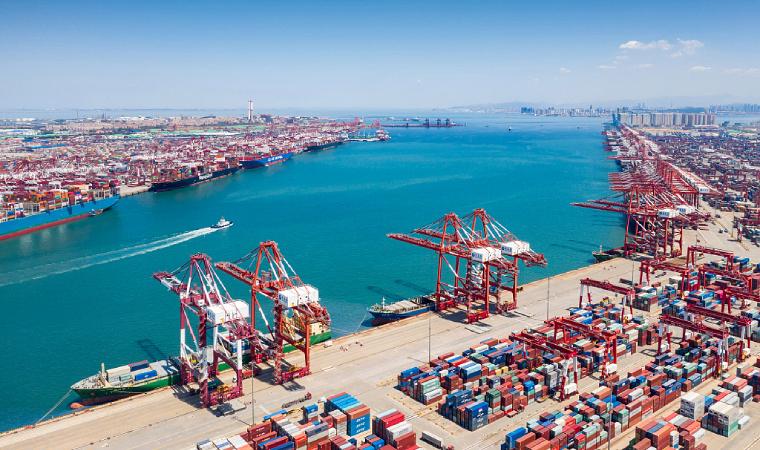
The report notes that international trade has remained resilient over the past few years, despite many major economic shocks, with global merchandise trade increasing by 6.3 per cent by the end of 2023 compared to 2019, and trade in services maintaining an even higher growth rate of 21 per cent per annum over the same period.
The report projects that inflation is expected to ease gradually between 2024 and 2025, with developed economies returning to realising real income gains, which in turn will stimulate consumption of manufactured goods. The recovery in demand for traded goods is already evident in 2024, which is inextricably linked to the expected increase in incomes as well as higher household consumption.
The report also notes that optimistic forecasts of a rebound in international trade face downside risks due to ongoing geopolitical tensions and policy instability. Conflicts in the Middle East have disrupted maritime routes between Europe and Asia, while tensions in other regions could also lead to trade fragmentation. In addition, the rise of trade protectionism could similarly affect the trade recovery in 2024 and 2025.