
Major international channels publish "report cards" China's foreign trade resilience
"We must see the competitiveness, resilience and advantages of China's foreign trade." Wang Shouwen, international trade negotiator and vice minister of the Ministry of Commerce, said at an April 4 news conference held by the State Council Information Office. At present, the "report card" of major international channels is showing the resilience of China's foreign trade.
Relevant experts believe that the economic and trade ties between countries along the "Belt and Road" and China are gradually strengthening with the momentum of recovery, but under the pressure of still severe internal and external risks, China should also do a good job in policy protection and solve the practical problems of foreign trade enterprises.
Railway trains in full bloom
"China's economic recovery this year will provide impetus for my foreign trade." Wang Shouwen pointed out that China's PMI manufacturing purchasing managers' index has been above the boom and bust line for three consecutive months, and China's logistics index released by the Logistics Association on April 3 has risen for two consecutive months, reaching 55.5% in March.
"This shows that the domestic economy is recovering, and the economic recovery has a traction on the demand for imported products." Wang Shouwen said.
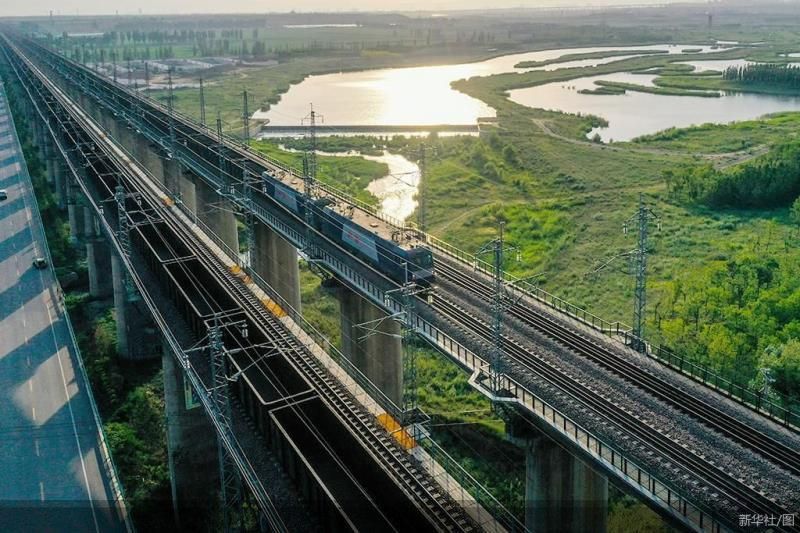
Data show that in the first quarter of 2023, the rail-sea combined transport train of the western land-sea new channel sent 191,000 TEUs of container cargo, a year-on-year increase of 11.7%, continuing to maintain a strong growth trend. During the same period, the Laos section of the China-Laos Railway operated a total of 954 freight trains, a year-on-year increase of 112.47%, and sent 667,600 tons of goods, a year-on-year increase of 261.65%.
In addition, the China-Europe Express also achieved good results in the first quarter. A total of 256 China-Europe trains (Wuhan) were opened, a year-on-year increase of 187.6%, of which 59 trains were opened and 197 trains arrived, an increase of 47.5% and 302.2% respectively year-on-year; China-Europe Express (Hefei) shipped a total of 340 trains in the first quarter of this year, a year-on-year increase of 49.78%; The China-Europe Express (Qilu) operated a total of 506 trains, a year-on-year increase of 9.5%. In addition, as of 0:00 on April 1, a total of 238 China-Europe trains had departed from the Beijing-Tianjin-Hebei region, a year-on-year increase of 6.7%.
"In the first quarter, major international corridors achieved good transportation results, one of the reasons is that after the optimization of epidemic prevention and control policies, our economy recovered rapidly, and cross-border trade increased." Song Xiangqing, deputy dean of the Institute of Government Management of Beijing Normal University, told a reporter from Beijing Business Daily.
Constantly strengthening economic and trade system
"These achievements mean that the economic and trade ties between countries along the Belt and Road and China are strengthening, and it also means that there is more room for cooperation between countries along the route and China." Song Xiangqing said.
According to Chen Jia, an independent international strategy researcher, the China-Laos Railway is the first modern railway in Laos, which connects China, Laos and the Lao-Thailand Railway, and is an important part of the Trans-Asian Railway. As of April 3, the China-Laos Railway has been in operation for 16 months, during which its cargo shipments have increased significantly and the variety of goods has become more abundant, expanding from more than 100 at the beginning of its opening to more than 2,000.
"Judging from the richness and scale growth of its trade categories since its opening and operation, the role of the China-Laos Railway as a 'golden corridor' in Southeast Asia in the 'Belt and Road' strategy has become increasingly prominent, which can not only directly drive the economic and trade relations between China and Laos, but also further deepen indirect trade between China and ASEAN member countries." Chen Jia introduced, "For example, Thailand has used the cold chain special train of the China-Laos Railway to deliver local fruits to China, showing ASEAN countries the unique and efficient transportation mode of China-Laos Railway segmented transportation and port road connection. ”
On the whole, Song Xiangqing believes that the achievements of multiple channels reflect that China is developing a more diversified foreign economic and trade market, and gradually establishing an economic and trade system that combines domestic circulation and domestic and international dual circulation. "On the one hand, in addition to the United States and African countries, our economic and trade ties with Southeast Asia, Central Asia and Europe are also constantly strengthening, and the support points for foreign economic exchanges are more and stronger." According to Song Xiangqing, "On the other hand, in addition to sea and air transportation, the role of railway transportation is more prominent, so that our international logistics presents diversified and three-dimensional characteristics." ”
Work together to mitigate risks
While the recovery signal of foreign trade continues to be released, the pressure of internal and external risks also exists. "From the perspective of macro trade sectors, despite the accelerated recovery and stabilization of China's macroeconomy, the pressure of domestic and external risks to promote the stable development of China's foreign trade in 2023 will remain severe." Chen Jia said that from the regional trade data from January to February, especially the export growth rate, the pressure of traditional trade strong provinces to stabilize foreign trade has become increasingly prominent, how to further play the effectiveness of the policy of promoting foreign trade continuation, and give full play to the leading role of foreign trade strong provinces in the national trade sector, it is also necessary for all parties in the trade industry chain to work together.
To this end, Chen Jia believes that at the macro trade level, China must continue to adhere to the optimization of trade structure and appropriately adjust the weight of trading partners. "Due to the recent series of thunderstorms in the European and American financial markets, the systemic risks of a hard landing of the US economy and stagflation in the euro area are still high, and it is expected that the negative effect of the traditional three trade powers Europe, the United States and Japan on China's trade pull will continue in the short term; The positive effect of ASEAN, Russia, South Korea and so on on China's trade will be amplified. ”
Chen Jia said: "From the perspective of the trend of global trade categories, the consumer electronics market has not yet fully ushered in the spring, the growth rate of traditional electromechanical and high-tech products is slowing down, and the green energy field is growing against the trend. ”
"Under the current severe situation in which global trade is hit by multiple risks such as the recession of developed economies and artificial decoupling and chain breakage, China's foreign trade sector adheres to independent innovation, relies on scientific and technological progress, and continuously optimizes supply chains to overseas and cross-border trade platforms, which is expected to break through development bottlenecks." Chen Jia said.
According to Wang Shouwen, the relevant departments of the Ministry of Commerce have proposed to do a good job in policy guarantees, promote the capture of orders, cultivate market entities, and ensure the performance of contracts; It is necessary to actively promote the development of new foreign trade formats and stabilize processing trade; We must make good use of open platforms and trade rules, continuously optimize the business environment, and continue to expand imports.
"In accordance with the arrangements of the central authorities, we have vigorously promoted the style of investigation and research in the field of foreign trade, truly found out the difficulties encountered by localities, especially foreign trade enterprises and foreign trade industries, helped them solve problems, and contributed to the stable development of foreign trade and economic growth." Wang Shouwen said.